
BioNIQ technology for nutrient removal
BioNIQ technology is modular and available in a range of configurations, depending on the required capacity and application.
Nutrient removal
For nutrient removal, the BioNIQ system is connected to a drainwater storage silo and operates as a batch process. Once the silo is full—or whenever treatment is required—the process can be started. The water continuously circulates through the system until the desired water quality is achieved. Sensors provide real-time insight into the treatment process, indicating when the nutrients have been removed and the water is ready for discharge or reuse.

Partners


Nutriënten verwijdering met BioNIQ
Capacities
The required capacity depends on the amount of nitrogen—and, where applicable, phosphate—that needs to be removed. The most suitable BioNIQ model is therefore selected based on the volume of the storage silo and the composition of the drain water. Thanks to its modular design, there is a suitable configuration for almost every situation. Each model number refers to the diameter of the column, measured in inches. For example, NP-20 has a column diameter of 20 inches. Other available models include NP-24, NP-32 and NP-40.
Wondering which configuration is right for you? Get in touch with us at the bottom of this page to discuss a tailored solution, including a cost estimate.

BioNIQ NP-20
The BioNIQ NP-20 is the smallest model in the BioNIQ range. This compact system is designed to treat smaller storage silos with a capacity of up to approximately 10 m³. Its compact footprint makes the NP-20 an efficient solution for applications with lower treatment capacity requirements.
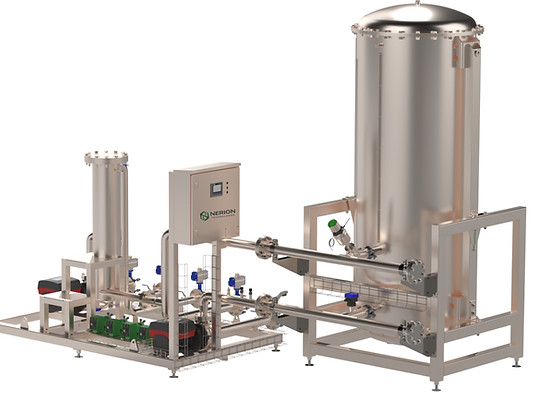
BioNIQ NP-40
The BioNIQ NP-40 is the largest standard model in the BioNIQ range, designed for applications requiring higher treatment capacity. Thanks to its modular design, capacity can easily be increased by adding additional units.
BioNIQ in practice
Case study: treating nitrogen-rich brine

Challenge
Membrane technologies are increasingly used to purify water and enable water reuse. However, the concentrated brine they produce contains elevated levels of nitrogen and cannot be discharged directly.
Conventional denitrification technologies have limited effectiveness when treating brine due to its high salt content. The salt inhibits the activity of denitrifying bacteria, making nitrogen removal less efficient.
Brine composition
EC

5.71 mS/cm
N-

3099 mg/L
Results
In this field trial, RO brine was continuously treated with BioNIQ through recirculation from a storage tank.
Stable nitrate removal at high initial concentrations (~3.100 mg NO₃⁻/L)
Linear removal profile
High and stable removal rates, even at elevated EC levels

A comparison of available technologies
BioNIQ
Flexible nitrogen removal
Diluted wastewater and brine
Batch / recirculating process
Easy to switch on and off
Low maintenance
Fast and compact thanks to immobilisation
(~440 mg-/L.h)
Automatic “quality OK” signal for controlled discharge
Activated sludge
Conventional denitrification technology
Diluted wastewater
Continuous operation required
Not suited to intermittent operation
Sludge management required and not suited to fluctuating concentrations
Lower conversion rate
(50-200 mg-/L.h)
Requires continuous monitoring
Ion exchange
Resin-based denitrification technology
Diluted wastewater
Batch or continuous process
Easy to switch on and off
Needs regular regeneration using salt
Separation technology that produces a concentrated (but not 100% pure) brine waste stream
Saturation requires monitoring.
Want to learn more?
Get in touch!
Bronland 10
6708 WH Wageningen
The Netherlands
085 - 800 66 99
